

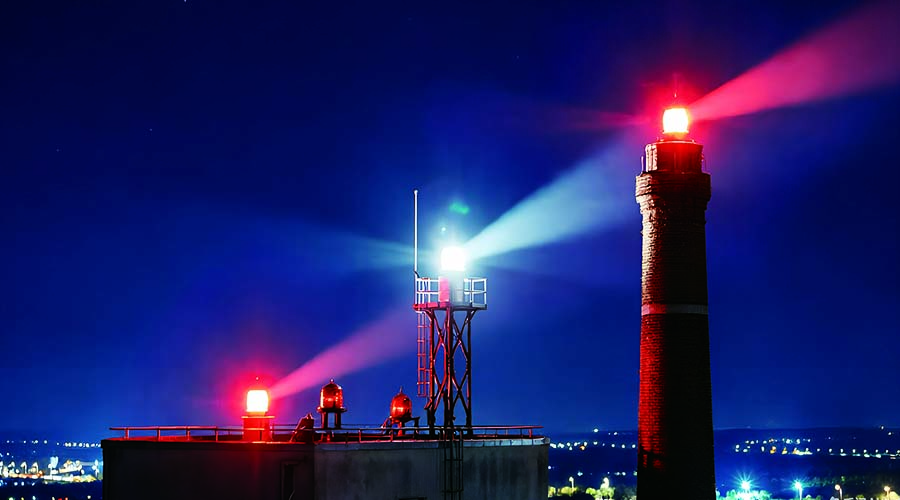
High-Intensity Obstruction Lighting for Saudi Arabia & UAE Climates
High-intensity obstruction lighting for desert climates requires specialized thermal management, IP68 ingress protection, and UV-stabilized optics. Engineered to withstand ambient temperatures exceeding 55°C and severe dust abrasion, these systems ensure continuous 200,000-candela daytime operation on tall structures while maintaining ICAO, GCAA, and GACA compliance across Saudi Arabia and the UAE.
What Challenges Do Desert Environments Pose to Obstruction Lighting?
Installing high-intensity aircraft warning lights on structures above 150 meters in the Middle East presents environmental stressors that degrade standard commercial LEDs.
- Thermal Degradation: Ambient temperatures reaching 50°C to 55°C—combined with solar radiation heating metal housings up to 80°C—cause junction temperature spikes. Unmanaged heat accelerates LED luminous decay and leads to premature driver failure.
- Particulate Ingress & Sand Abrasion: Fine silica dust from frequent sandstorms penetrates poor enclosure seals, coating internal optics and scratching glass lenses, which reduces optical transmission and alters beam divergence.
- High UV Index: Intense UV exposure degrades synthetic seals, gaskets, and polycarbonate lenses, making them brittle and prone to moisture entry during rare heavy downpours or high condensation cycles.
- Power Grid Volatility: Remote industrial facilities, flare stacks, and transmission towers often run on generator power or long cable runs, exposing fixture electronics to voltage surges and harmonics.
Core Engineering Requirements for Extreme Heat & Sand Resistance
- High-intensity lighting fixtures installed across the GCC must incorporate specific structural design choices to maintain operational integrity over a 100,000-hour lifespan.
| Engineering Factor | Standard Aviation Fixture Spec | Extreme Climate / Desert Spec |
| Ingress Protection (IP) | IP65 / IP66 | IP67 / IP68 (Hermetically Sealed) |
| Operating Temperature | -20°C to +45°C | -40°C to +70°C ambient rated |
| Lens Material | Standard Polycarbonate | Tempered Borosilicate Glass (UV & Scratch Resistant) |
| Thermal Dissipation | Passive Aluminum Extrusion | Copper Heat Pipes + Marine-Grade Powder Coated Aluminum |
| Surge Protection | 5kA – 10kA | 20kA Multi-Stage Surge Suppression (SPD) |
| Daytime Beam Output | 200,000 cd (Flashing White) | 200,000 cd with Automated Optical Output Compensation |
Advanced Thermal Management & Passive Cooling
High-intensity LED fixtures require active thermal control without vulnerable moving parts like cooling fans, which fail quickly in dusty environments. Marine-grade die-cast aluminum housings featuring vertical cooling fins utilize natural convection to dissipate heat from the LED array.
Optical Integrity Under Constant Sand Scouring
Borosilicate glass lenses replace plastic optics to eliminate yellowing and scratching from windborne sand. Sealed optical chambers filled with dry nitrogen prevent internal fogging caused by rapid temperature drops during desert nights.
Regulatory Compliance: ICAO Annex 14, GCAA, and GACA Standards
Installing aviation warning lights on tall chimneys, supertall skyscrapers, or lattice towers in Saudi Arabia and the UAE requires strict adherence to international and local civil aviation frameworks:
- GCAA (UAE General Civil Aviation Authority): Mandatory compliance for all structures exceeding 45 meters, requiring certified high-intensity Type A lights (200,000 cd day / 20,000 cd twilight / 2,000 cd night) on structures over 150m.
- GACA (Saudi Arabia General Authority of Civil Aviation): Enforces strict redundancy and backup battery mandates. Lights must feature dual power drivers and fault signal monitoring integrated into local BMS (Building Management Systems).
- ICAO Annex 14 Volume I: Dictates light distribution, beam spread, and multi-tier layout rules for structures of varying heights.
Maintenance Realities & Remote Monitoring via GPRS
Servicing obstruction lights mounted on a 250-meter stack or offshore flare structure requires specialized climbing crews or crane setups. Unexpected downtime risks severe regulatory fines and aviation hazards.
Deploying high intensity obstruction lights with integrated GPRS/GSM telemetry modules enables real-time monitoring of:
- LED string failure or lumen drop
- Power supply voltage fluctuations
- Internal fixture operating temperature
- Day/Night photocell state transitions
Remote diagnostics allow maintenance crews to bring the precise replacement component on the first ascent, cutting tower climbing operations by over 60%.
How Instapower Engineering Eliminates Desert Obstruction Safety Risks
When mission-critical infrastructure operates in the world’s most unforgiving environments, off-the-shelf lighting is an expensive liability. Instapower engineers and manufactures ICAO, GCAA, and GACA-compliant high-intensity aviation obstruction lighting designed ground-up for GCC conditions.
By combining marine-grade corrosion resistance, IP68 hermetic sealing, thermal-choked copper heat pipes, and borosilicate optics, Instapower systems eliminate the premature failures, fogging, and lens scratching that plague standard units. Backed by over two decades of manufacturing excellence, Instapower delivers end-to-end reliability across energy grids, telecom networks, mega-chimneys, and skyscrapers across India, UAE, and Saudi Arabia.
Ensure your high-rise assets remain fully compliant and operational in any climate. Contact us today to request a customized lighting calculation and technical project quote.
Frequently Asked Questions
What intensity is required for structures over 150 meters in Saudi Arabia and the UAE?
Structures over 150 meters typically require ICAO Type A high-intensity aviation lights. These units automatically adjust output, producing 200,000 candela during daytime, 20,000 candela during twilight, and 2,000 candela at night.
Why do standard polycarbonate lenses fail in Middle Eastern installations?
High UV radiation degrades polycarbonate over time, causing discoloration and micro-cracking. Additionally, airborne silica sand during dust-storms scratches soft plastic lenses, scattering light beams and reducing effective visibility below legal aviation thresholds.
How do heat-engineered aviation lights prevent LED degradation?
Extreme climate fixtures use copper core PCBs, passive convection fins, and marine-grade aluminium enclosures to draw heat away from the LED junction. This keeps operating temperatures low without relying on mechanical fans that get clogged by desert dust.
Operating high-rise infrastructure in harsh desert conditions requires zero compromises on aviation safety. Partnering with an experienced manufacturer like Instapower ensures your facilities meet all international and regional civil aviation mandates while minimizing long-term maintenance costs and operational risks.
Leave a Comment