

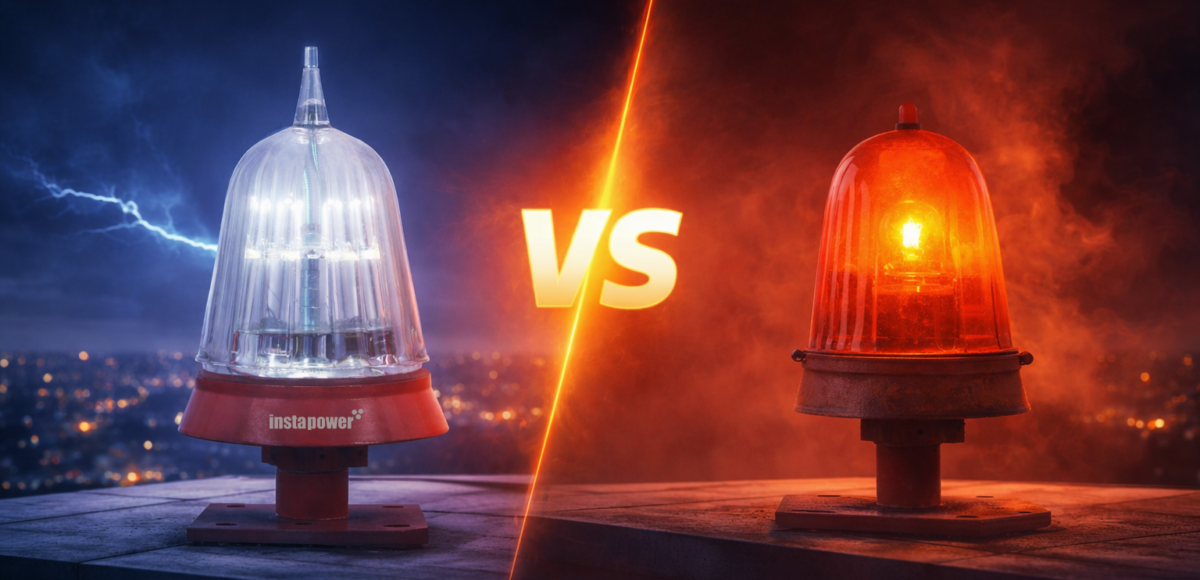
LED Aviation Warning Lights vs. Traditional Lighting
When it comes to high-rise structures—be it a telecommunications tower in the bustling streets of Dubai or a massive wind turbine in the coastal plains of India —aviation safety is non-negotiable. For decades, traditional incandescent or halogen lamps were the standard for aviation obstruction lighting. However, the industry has seen a massive paradigm shift towards LED.
Today, LED (Light Emitting Diode) technology isn’t just an alternative; it is the global benchmark. But why exactly are engineers and project managers moving away from traditional bulbs? Let’s break down the technical reasons and see how this change is saving lives and costs.
The Technical Edge: Why LEDs Win
1. Longevity and Maintenance Cycles
Traditional filaments are fragile. Between the constant vibration from wind and the thermal stress of cycling on and off, incandescent bulbs typically last only about 1,000 to 2,000 hours. In contrast, LED aviation lights are solid-state electronics. At Instapower, our LED solutions are designed to have lifespans of 50,000 to 100,000 hours. For a site manager, this means fewer dangerous climbs to the top of a chimney or tower to replace a burnt-out bulb.
2. Energy Efficiency & Low Heat Dissipation
Traditional lighting wastes about 90% of its energy as heat. LEDs are incredibly efficient, consuming very little wattage, 10% of conventional light wattage to produce the same (or better) candela output. This lower power draw is vital for solar-powered obstruction lights used in remote areas where “off-grid” reliability is essential.
3. Instant Illumination and Precise Optics
Halogen lamps take time to reach full brightness by generating a lot of heat. LEDs provide instantaneous “on” capabilities, which is critical for flash patterns in medium- and High-intensity lighting. Furthermore, LED light is directional, allowing us to use precision optics to ensure the beam hits the required vertical and horizontal angles without “light pollution” or wasted upward glow.
Global Standards: FAA & ICAO Compliance
In the aviation world, “bright enough” isn’t good enough. Strict international regulations govern safety. At Instapower, we don’t just manufacture lights; we manufacture trust.
Our range of aviation warning lights is fully FAA (Federal Aviation Administration) and ICAO (International Civil Aviation Organization) certified. Whether you require Type A, B, or C Low-Intensity lights or complex Medium and High-Intensity strobe systems, our products meet the rigorous photometric and chromaticity requirements set by these global bodies.
Powering the Skies: Instapower’s Role in India and the Middle East
Aviation safety needs to withstand extreme environments. From the humid coastal regions of India to the scorching desert heat of the UAE, Oman, and Qatar, the hardware must be rugged.
Instapower has emerged as a leading force in these sectors. We understand that a lighting failure in the middle of a sandstorm in Doha or a monsoon in Mumbai isn’t just a technical glitch—it’s a flight safety hazard.
We are a leading aviation warning lights manufacturer in India, supporting the nation’s infrastructure boom in telecom and renewable energy.
In the UAE, Oman, & Qatar, we provide specialized lighting solutions that are UV-stabilized and IP-rated to withstand the intense Middle Eastern sun and dust, ensuring that skyscrapers and oil rigs always remain visible to pilots.
Summary:
Switching from traditional lighting to LED isn’t just about following a trend; it’s about choosing a system that is more reliable, more cost-effective, and infinitely safer.
As we continue to supply and support the aviation sectors across India and the Gulf, our mission remains clear: to provide lighting that never sleeps, so the skies stay safe.
Explore our full range of certified solutions at www.ledaviationlights.com, and let’s secure your skyline together.

Leave a Comment